

AI for Decision Making: what does AI have to say about this?


Artificial Intelligence (AI) has already been used in many areas of clinical development and clinical trial design such as patient recruitment and matching, trial design and protocol optimization, site selection and feasibility, and monitoring and risk-based management.
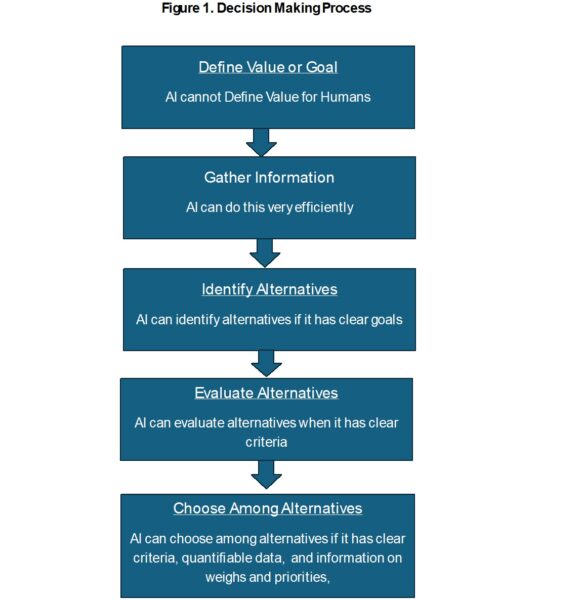
In this blog I am focusing on the potential role of AI in decision-making. To accomplish this, I interviewed OpenAI. I began by asking it to define steps in the decision-making process, and I received standard answers. I then asked for its capabilities to address the first five steps of this process. Conclusions at the end of blog are also using AI responses. I made only minor changes to them. These are the answers that I received:
1.Define the value or goal
No, AI cannot define the value for humans. It can only help with guidance from humans to know what to look for or how to define it. AI needs to know what we are trying to achieve. This then becomes the target the AI is optimizing toward.
2. Gather Information
Yes, AI can do this very efficiently. Most modern AIs learn by being trained on massive amounts of text, images, audio, or video collected from public sources. Some AIs are further trained on specialized data.
3. Identify Alternatives
Yes, AI can help identify alternatives efficiently when it has clear goals to work from. To identify useful alternatives AI needs a well-defined goal and specific constraints. Once this is completed AI can simulate different alternatives’ paths and their outcomes.
4. Evaluate Alternatives
Yes, AI can evaluate alternatives objectively and efficiently when it has clear criteria and good data. Some methods applied by AI for data evaluation are scoring and ranking options, multi-criteria decision analysis, predictive modeling, optimization, or sentiment and feedback analysis
5. Choose Among Alternatives
Yes, AI can select among alternatives after completing the first four steps. It needs clear criteria, quantifiable data and information on weights and priorities. AI then ranks alternatives with explanations and trade-offs.
AI can seriously boost the efficiency of decision-making in many ways. It processes and analyzes large volumes of data much faster than a human. AI finds patterns, trends, and anomalies that would take a long time to uncover manually. It can also give recommendations on the fly. However, while AI is powerful assistant, humans are still essential for identifying values and goals, framing the question, and making sense of the insights.
Zoran Antonijevic is Chief Scientific Officer at Bioforum. He held executive positions in Pharmaceutical Companies and CROs and designed more than 100 clinical trials in numerous therapeutic areas, many of which included adaptive designs. Zoran was a long-time Chair and leader of the DIA Adaptive Design Scientific Working Group. He has authored numerous papers and scientific presentations and was editor of books “Optimization of Pharmaceutical R&D Programs and Portfolios” and, together with Bob Beckman, “Platform Trials in Drug Development”.